
Shopping Mode
What it does
Section titled “What it does”1. Starting a trip
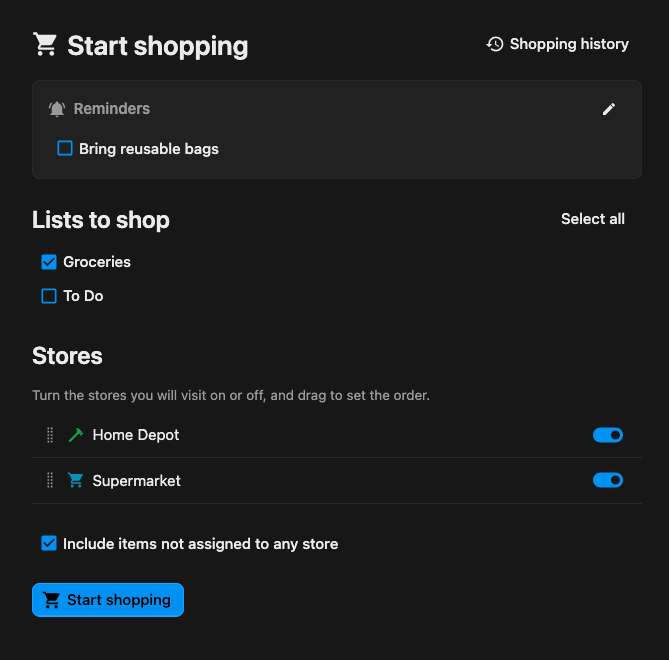
Section titled “1. Starting a trip”From any list (or All Lists) you open Start shopping. You pick:
- Which checklists to shop (pre-selected from where you launched).
- Which items the trip covers. The Items tile opens a picker holding everything still to buy on the selected lists, grouped by category: tick items one at a time, a whole category from its header, or use All, None and Invert. The tile sums up what you chose — “All 23 items”, “9 of 23 items”. A trip covers everything unless you narrow it, so items that appear on the lists after you picked are shopped too; leaving nothing at all is not a trip you can start.
- Which stores you’ll visit, and in what order — toggle stores on/off and drag to arrange the route. Only stores that actually have unchecked items on the selected lists are offered.
- Whether to include items not assigned to any store (buy-anywhere items).
You shop one trip at a time. If you already have a trip running (even in another house), you’ll be offered Resume or End previous trip instead of silently starting a second one; if you are out on a housemate’s trip, Resume or Leave trip.
2. Shopping
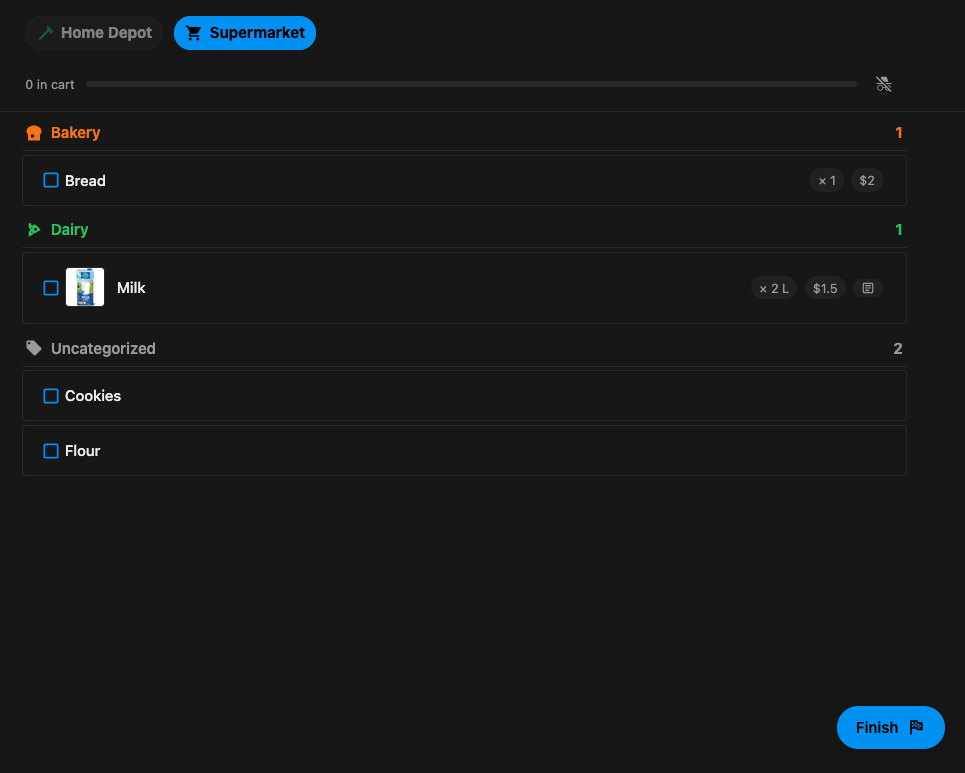
Section titled “2. Shopping”The trip view is a dense, single-column list of everything still to buy, grouped under sticky category headers, narrowed to the active store. Tapping a row checks the item off — it drops out of the list and into a Done drawer at the bottom (tap again to undo). A sticky bar up top shows your store sequence and progress; tap a store to jump to it, or use the floating action button to move to the next store / finish.
The list refreshes about once a minute (and immediately when you return to the tab), so if a housemate checks something off, it disappears from yours too. A trip has a single shared check log, so on a trip you share with a housemate their ticks land in your Done drawer rather than silently vanishing from your buy list.
Categories are grouped in the order you walk the store you’re in — see per-store category order below.
3. Shopping together
Section titled “3. Shopping together”While you shop, your session sends a lightweight heartbeat. Housemates’ avatars appear on the store bar next to the store each person is currently shopping, so nobody double-shops. Presence is approximate and forgiving (it fades after ~15 minutes of no activity, and pauses when your tab is backgrounded). If you’d rather not be seen, flip the shop privately toggle in the store bar — your trip is hidden from housemates’ presence (and later from their history).
When somebody is out shopping, a banner on your lists says so — “Alice is shopping at Supermarket”, or “Alice and 2 others are shopping” once a trip has several shoppers — with a Join button that puts you on their trip instead of starting one of your own:
- You shop the same items against the same check log. Whatever any of you ticks off drops out of everyone’s buy list.
- The store bar attributes the whole trip to its active store, so every shopper on it shows there.
- Whoever finishes the trip finishes it for everybody; the rest are told and sent back to their lists.
- Leave trip, from the start screen, steps you out without ending it for the others. The shopper who started a trip cannot leave it — closing it is their way out.
Joining while you have a live trip of your own offers to end and save yours first. A private trip never surfaces for housemates to join.
A trip belongs to the shopper who started it, so that is whose history it lands in. A trip you joined shows up under the house view of history rather than your own.
4. Reminders
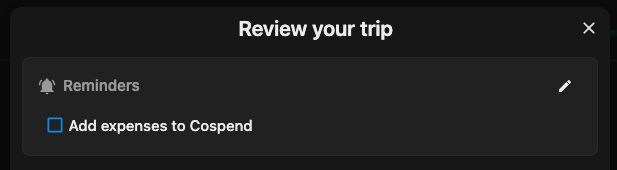
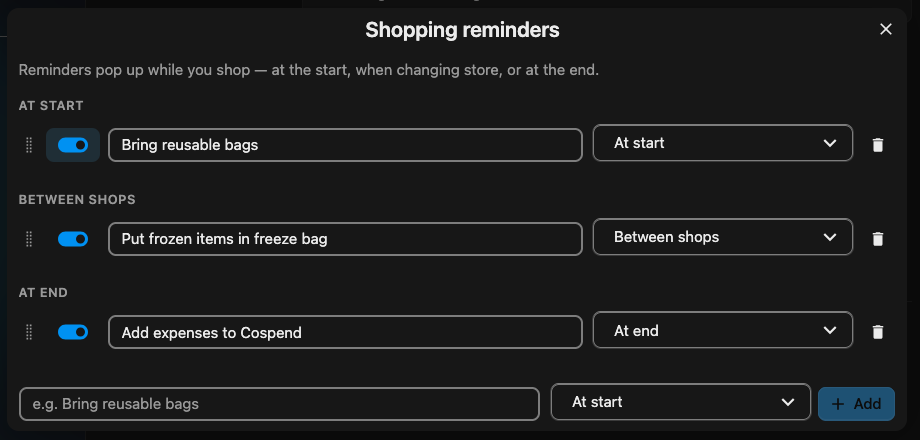
Section titled “4. Reminders”Households can define their own prompts — e.g. “Bring reusable bags”, “Check the freezer aisle” — that pop up at the moment they matter: at start, between shops, or at end. Manage them from House settings → Shopping, from the start screen, or inline while shopping. In the manager, reminders are grouped by moment into three drag-reorderable lists; each row has an enable switch, the text, and the moment it fires. Change a row’s moment to move it between groups. When a step has no reminders, you’ll see a small empty state with an Add reminders button.
While shopping, enabled reminders show as a small, non-blocking checklist at their moment — you can tick them off as you go, but nothing is required and the ticks are just for your own tracking (they don’t persist across a reload).
5. Finishing & review
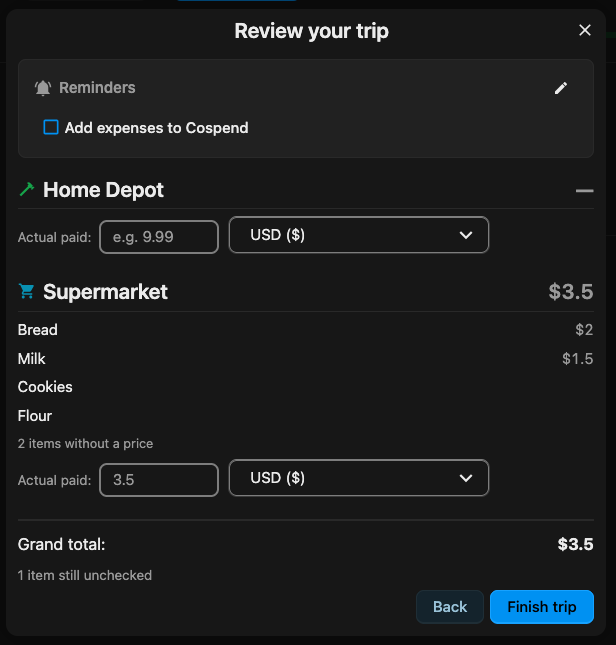
Section titled “5. Finishing & review”When you finish a store or the whole trip you get a review: items grouped by the store you bought them at, an estimated total per currency (from item prices, shown as a range when prices are ranges), and a field to enter what you actually paid per store (or for the whole trip if you shopped storeless). Finishing stamps the trip closed.
6. History
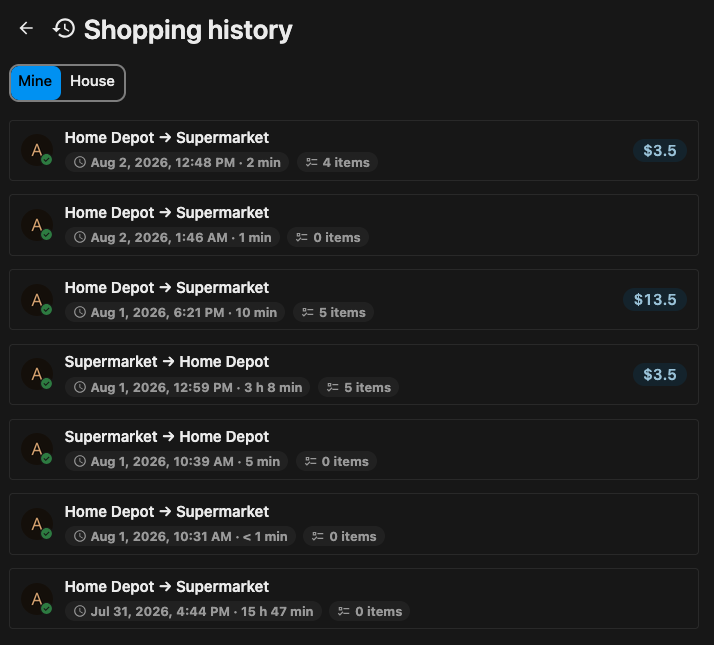
Section titled “6. History”Finished trips land in Shopping history (linked from the start screen). Each row shows the store route, item count, duration, and total; opening one shows the same grouped review. You can view just your trips or the whole house’s (private trips stay hidden from housemates). Closed trips render from a snapshot taken at close time, so they stay intact even if the underlying items are later edited or deleted. Old trips can be auto-pruned via a configurable retention period (default: keep forever).
Got a total wrong, or paid at the till after the trip was closed? Edit totals, in the review of a trip you shopped yourself, reopens the amounts — what you paid per store, or the grand total for a storeless trip — and the history row follows the correction. Housemates’ trips stay look-only.
Per-store category order
Section titled “Per-store category order”Shopping mode groups items under category headers, and a shop is rarely walked in the order the house happens to list its categories. Open the category manager and choose Per-store order to arrange one: pick a store, then drag its categories into the order you walk its aisles. Use the shared order drops the arrangement and hands the store back to the house-wide order.
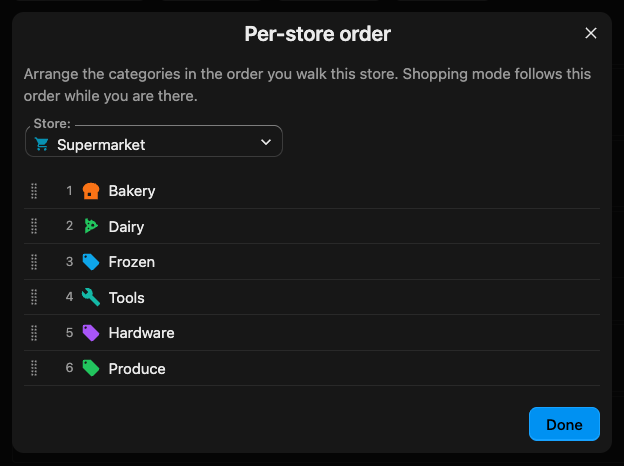
A store names only the categories it has been arranged with. Everything else — including one created after the arrangement — falls in after them, in the house-wide order.